


“The voice of the sea speaks to the soul.”
Kate Chopin
This morning I woke to the smell of the sea. The seaweed I collected is drying, the promise of inks and pigment, the antidote to my heavy heart upset by what we humans do to nature. It is sad to see.
As I walk it is impossible to escape the evidence of humans using sea and shore as a dumping ground.
I wonder what William Anderson Smith would make of it all. I’ve just finished his book Loch Creran, Notes from the West Highlands. In June 1883 he rowed passed where I walked.
“In spite of the lesson they received during the gales and high tides, the sand martens are busy on the sandbank at Shian where they have perforated it afresh with their burrows, to take the place of those flung ruthlessly into the sea.”
Perhaps naively I had been hopeful of seeing some of their descendants. But where are the sandbanks he talks of at Shian?
Although the industrialisation of Loch Creran had not started in his day he lived in the age of such ‘advancements’. It was the time of Empire. The hey day of industrialisation and colonisation, the power-over model which continues unabated to this day.
The monster of growth needs fed. Indoctrinating people through western education systems provided a work force and consumers. Generations have now been separated from their indigenous culture, languages and customs, swept up into this hungry machine.
Colonisation means the land and seas are no longer in the hands of local people. Instead they are now required to work for the global companies using the local resources while their products and profit go elsewhere.
Just as coal mines blighted the landscape in the thirst for cheap energy now the seas around the west coast of Scotland are marred by the aquaculture business. Loch Creran is a sad example of this industrialisation of nature. Set to double production by 2030 in Scotland alone, the global salmon farming business claims to be part of feeding the world.
I wonder how many of the people who are actually starving on this planet ever receive salmon to alleviate their hunger?


My walk began following in the footsteps of my 2016 walk. This delightful grassy stretch is lined by trees and a bank of wild flowers separating me from the fields. It’s called Poll Nan Ron on the OS map which means pool of the seal. Not sure seals are seen here nowadays, although they are still around.
The narrows open up into a large muddy bay. It’s a couple of hours before low water so I strike out across the gloop. First find, a hobnail boot heel, then an old rusty hoe. I suspect both belong to the cocklers.
Do they still collect cockles here?
Ever since I heard about a piece of research done on the loch I have wondered about the cockles and for that matter all the other shellfish around the loch. Titled Potential impact of aquaculture effluents in Loch Creran, Scotland, this research by C Ciocan a principle lecturer at Brighton Universty, concludes:
“The observed histopathology in the mussel samples from the aquaculture site are an indicator that the mussels in this area are under environmental stress. Many individuals exhibited signs of stress induced by metal pollution. The overall heavy metal levels were above BAC in the tissues and EU standards in the water at both sites, suggesting that the aquaculture activities are impacting on the health of the entire loch. The chemicals routinely monitored by SEPA were not found in the water or mussel tissue samples in either area. However, most of the organic compounds identified by GC analysis were found in the mussel tissue and seawater samples in area A, close to aquaculture site. Our results indicate that the typical organic pollution encountered on the developed coastlines is exacerbated by aquaculture activities. Further research is needed to establish the impact of these compounds on the health status of natural populations of M. edulis.”
BAC means background assessment criteria.
To me, this research published in 2019 should be ringing major alarm bells around the loch.
If the mussels are affected, what about the protected species, the serpilid worms, the horse mussels and the flame shells? And, what about the the shellfish consumed by humans, is it safe?
The salmon farm referred to has been fallow since Aug 2022 due to catastrophically high mortality rates. Wouldn’t it be sensible to check the mussels again, now, to find out how they are after 4 years without the aquaculture effluents.
There are plans to restock the fish farm, what happens then?
My head is full of such questions as I sit to take a break by the narrows before the salt marsh opens up at Balure. It’s beautiful here, but there it is, the plastic, a net bag, maybe left by a cockler.
Next I find a route across the burn that flows out from Balure and head for a rusty gate. Once at the Shian Wood car park I head across the first field towards the woods then strike left across and down to the corner style to meet the shore again.
It’s a grassy walk again beneath the woods with beautiful views back towards Eriska and on to South Shian bay where the grass abruptly ends. A sand and gravel bank lead round into South Shian bay and the beginning of the South Shian and Balure SSSI. This Site of Special Scientific Interest is “a key area for studies of late-glacial environments and chronology.”
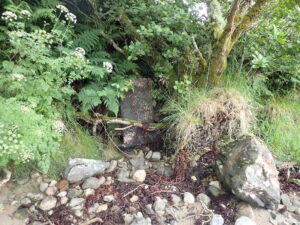
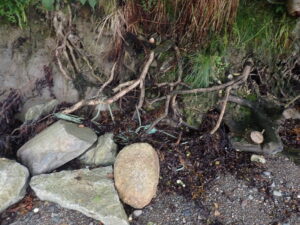
Here I find a couple of oyster farm bags wedged in the exposed tree roots and what looks like significant erosion of the bank. Is this a problem given its significance?

As the old ferry slip comes into view I think of my childhood. My Dad kept his boat here in the 70’s and 80’s so it is very familiar territory. You can read what Dorothy Wordsworth had to say about her ferry trip on the Ardchattan Parish Archive. She wasn’t very complementary.
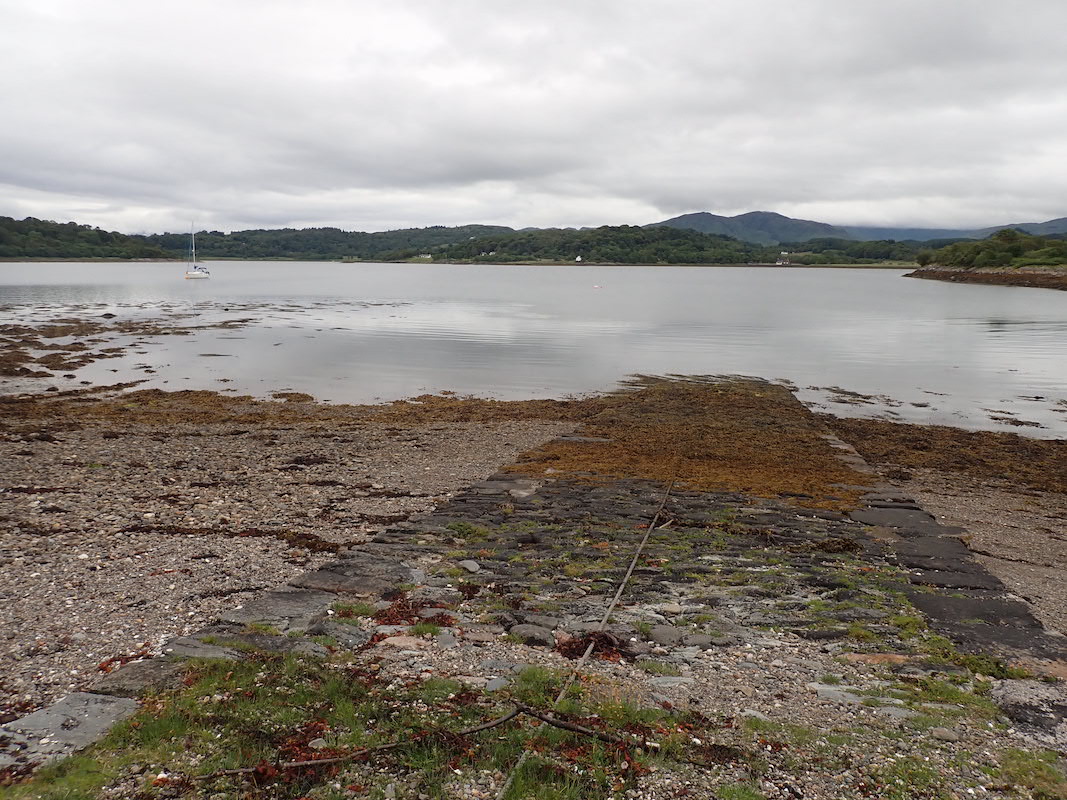
I decided to walk the length of Sgier Caillich island again but this time stick mainly to the middle as it’s steep to, hard going and my knee hurts. I picked my way past the oyster farm nestled in the shallows and set off over the rocks, then through the head height bracken.
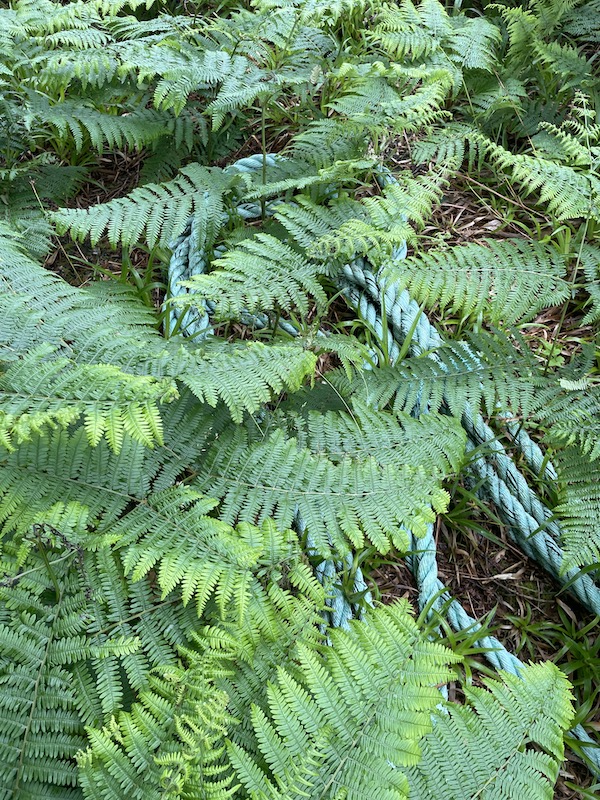
The huge anchors and chain were still lying on the rocks but the floats seen in 2016 had gone. I did however find a big section of blue rope right in the middle of the island. At the end I stopped for lunch and enjoyed watching the seals watching me.

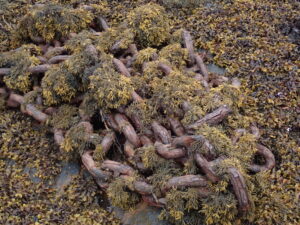
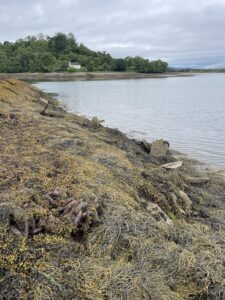
The island is beautiful, a microcosm of unspoiltness, full of native trees, flowers, lichens and mosses.
As I watched the quarry boat speeding in and saw its big bow wave hit the shore I did wonder how much this might add to the erosion of the SSSI. Why aren’t there any speed restrictions in place? I’ve nothing but questions on this walk.
Once safely back I set off along what is sadly another shoreline full of trash. This time it’s concrete. Strewn all the way from the crater site ( a second world war bomb was dropped here thinking the island was a submarine) to the SSF fish processing plant there is concrete in various stages of breaking up. Where did this come from? It looks suspiciously like something big was broken up and the pieces shoved away up along the tree line.


By the fish processing plant there is the most rubbish I’ve seen so far. Right below the staff picnic benches is a section full of seaweed strewn with plastic, as well a huge old strap. Along the edge from there plastic net has come loose from what looks like attempts to stop the bank erosion along where their lorries park.
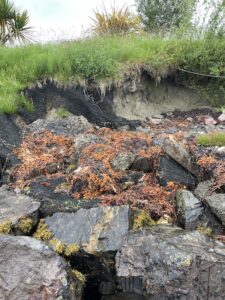
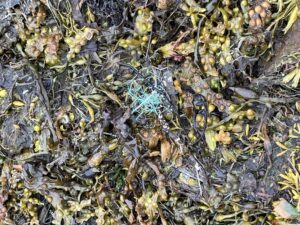
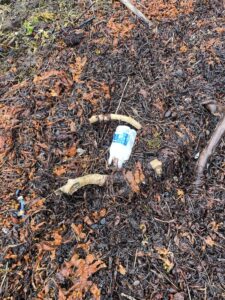
Why don’t they clean up their own section of beach?
Further on there is a slightly suspect looking seepage, and a couple of places where concrete has been poured over the edge onto the beach, then thankfully nothing too much. A few bits of plastic, a piece of clothing and some pipe.
Then I find a native oyster shell on the sand. What a delight. The old 1800’s chart shows oyster beds on this loch. I wonder how many remain? There are lots of other shells around too which is heartening, I just hope they are not being poisoned like the mussels.
Along from here the pacific oyster shells debris from the farm round the corner begins in earnest. I’ll leave my questions about that and oyster farming until the next walk. Instead let me end with this.
Can you believe it, I forgot to bring my felt pod!
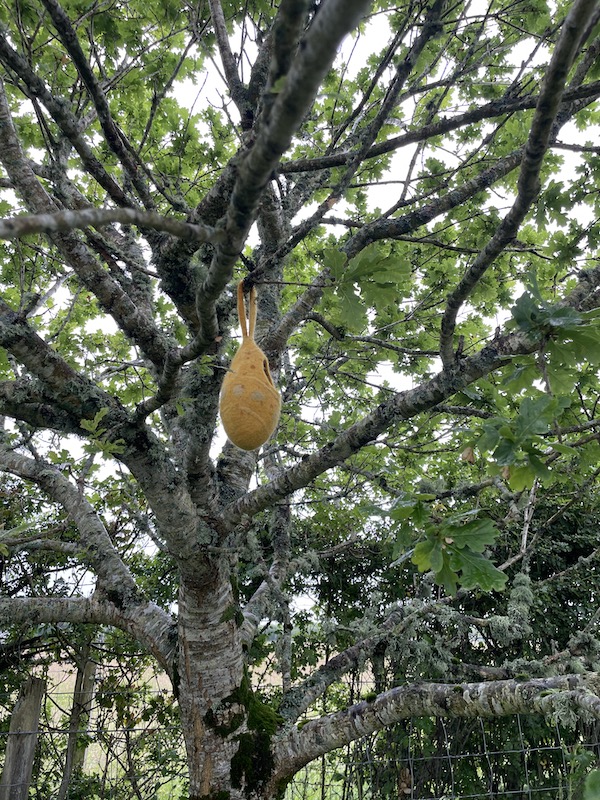
Luckily my husband dropped it off and I was able to hang it in a little oak tree on the last section of this walk. I sat there and looked up the length of the loch. It is beautiful even on a wet drizzly day. I think about the last few pages of William Anderson Smith’s book.
“Three porpoises are disporting in our own loch ere we leave it, and as they have been there for some few weeks must be finding fish of some sort.”
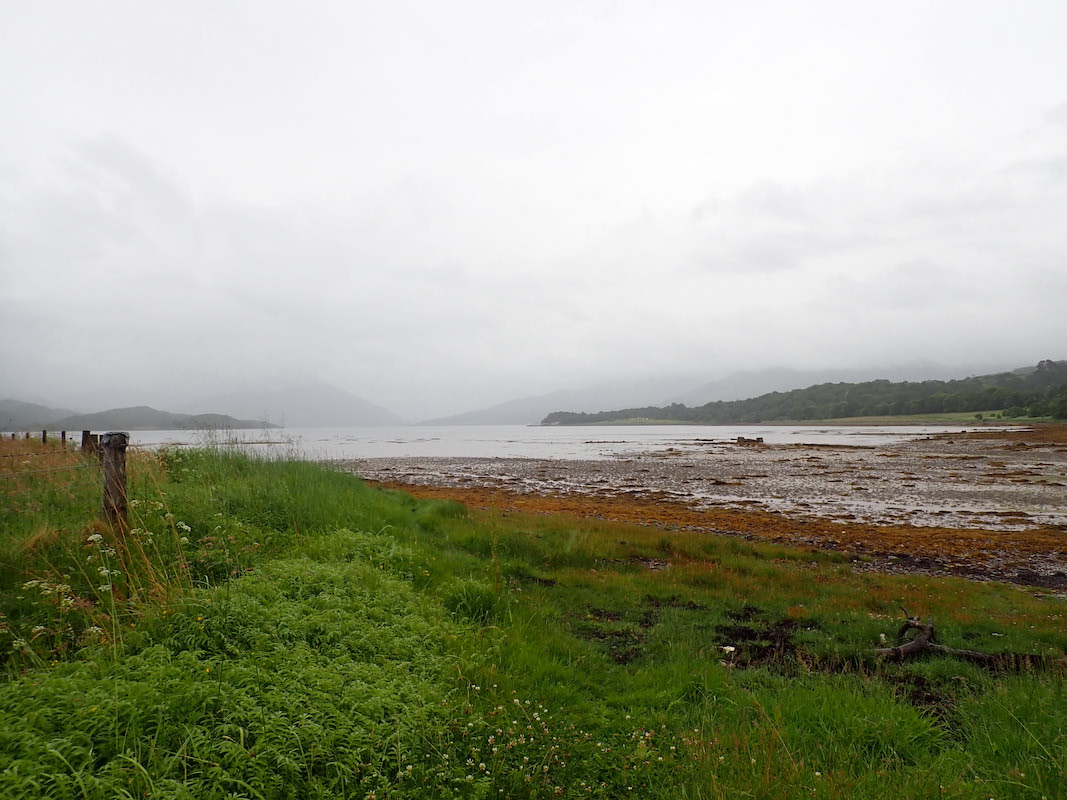
In 21 years beside this loch I have never seen or heard of porpoises visiting. I wonder what someone 150 years hence will see or not see on and under this loch. Wouldn’t it be fantastic if they were able to look back and know that we cared enough to protect it, to help it regenerate and become a thriving example of what thoughtful humans can do when they decide to do no harm.
“When you turn a blind eye to atrocities, you are complicit in them.”
David Crossman
Walks 3-5 in 2016 cover this walk and provide lots of other information about the area.

About the Author: Mairi

2 Comments
Leave A Comment
Latest Ripples
"What we most need to do is to hear within us the sound of the [...]
"The voice of the sea speaks to the soul." Kate Chopin This morning I [...]
“The care of the Earth is our most ancient and most worthy, and after all [...]
"The question is not what you look at, but what you see." Henry David Thoreau [...]
“Instructions for living a life: Pay attention. Be astonished. Tell about it.” Mary Oliver After [...]
"As you move toward a dream, the dream moves toward you." Julia Cameron At last [...]
“Every artist was first an amateur.” Ralph Waldo Emerson As the painting continues I faced [...]
"We tend to think being hard on ourselves will make us strong. But it is [...]
“Tenacity is when you follow your heart—when the whole world is screaming to get back [...]

This is an emotional read for me, Mairi. Such vivid memories of South Shian: the baby seal, diving down to check the moorings, standing in the drizzle, rowing the dinghy out to the boat. How did we fit six people and a dog and the outboard motor and all the other stuff into the car??!! So sad to hear about all the pollution.
Yes, the amount of stuff littered around the shoreline is distressing. On a positive note the baby seals are still around. At the end of the island there were actually quite a few bobbing around. I seem to remember the pup we saw was white, if so it was a grey seal whereas the ones I saw on this walk are Common Seals.