


“The question is not what you look at, but what you see.”
Henry David Thoreau
Monday, 1st of June 2026 my walking began. Huddled out of the rain I felt emotional. Unlike before when I walked for my own satisfaction, this time I am walking for the loch. Like much of nature it does not have a voice, no seat at the table to tell us why its rare and globally significant reefs are in such ‘Unfavourable Decline’.
The loch whispered to me, what she needs.
“To be loved, honoured and respected.”
Don’t we all wish for that.
Starting with a ritual asking for the loch’s blessing I lit a candle, made an offering, then sat and listened. “Go in peace, take your time, you are Nature.” Yes. I understand, separation is an illusion.
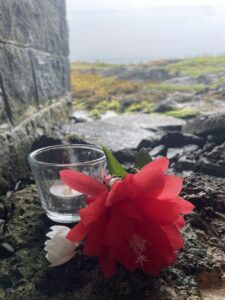
I set off round the bay marked as An Doirlinn on the map. Meaning Tidal Island or causeway it perfectly describes this area where a narrow channel separates the Isle of Eriska from the mainland. I had come as Wendell Berry says “into the peace of wild things”.
Sweeping my gaze back and forth things of interest soon came into view. Would you believe it, the first was an invasive species. Sargassum Muticum. Wireweed as its commonly known arrived in southern England 53 years ago having originated in the Pacific.
There are many such invaders now, on land and in the sea.
The great diaspora of species on the move across the world reflects our Colonial past and Globalised present. Brought on purpose or hitching lifts on the ever increasing global ocean traffic, these non-native species proliferate, out compete and smother.
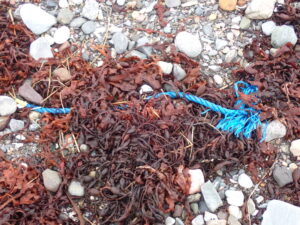
After the weed a surprise. The seaweed line around the head of the first bay was sprinkled with small dead crabs, their demise a mystery. Then a mussel farm float, tissue wrapper, milk bottle, plastic strap, a big clip and yes, the now ubiquitous blue rope. This menace of the seas most likely debris from the fishing and fish farming industries, roams the oceans ending up in seaweed tide lines up and down the beautiful coast line of Scotland.
Then whelks herald in a memory from walking ten years before. “There will more”, and there were. Whelk shells still fill a wee beach near the southern tip of the island. Niche habitats, precious places.
I sit, make a few notes and enjoy this familiar view. A yacht with royal blue sails passes by down the Lynn of Lorn closely followed by a fish farm boat heading into the loch. Looking over towards Eilean Dubh, I think about W. Anderson Smith and his trips there in the 1880’s. I’m reading his book Loch Creran, Notes from the West Highlands. His wildlife observations, knowledge and accounts of life by this loch are fascinating.
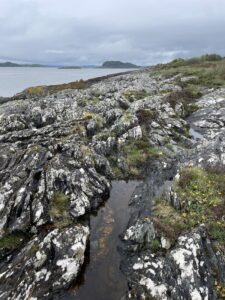
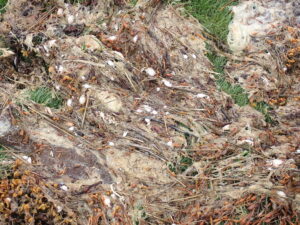
The next stretch is rocky, slippy and hard going, but comes up trumps with a child’s ball floating in a rock pool. Perfect. It will eventually contribute to something I will make to symbolise the plastic pollution. I already know there will be more, much more.
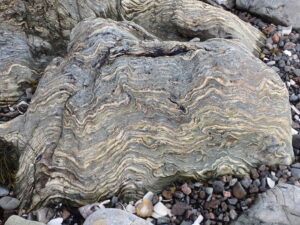
The long western side of the island is a fascinating area full of geological charm. Every step revealed more amazing waves of ancient rock. Over the last 6-700 million years these buckled layers have travelled the world, how amazing is that!
Trapped amongst this ancient history I find frayed rope shedding it’s micro plastics into our sea. Yes, it’s blue.
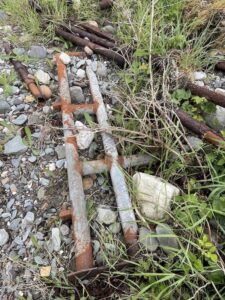
Apart from a small carnivorous plant the other structures worthy of note are metal. The worst being a pile that looks like old scaffolding or maybe gates. Why do we think chucking it on the shore is away?
Then an unpleasant smell wafts from a small stream emerging from the bank. Is this the hotel’s septic tank soak away? Better than what once travelled down the outflow pipes which punctuate the island coastline which, I hope, but do not know for sure, are now redundant.
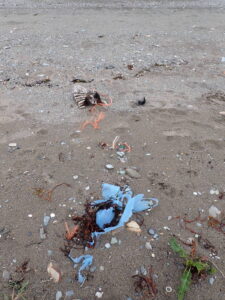
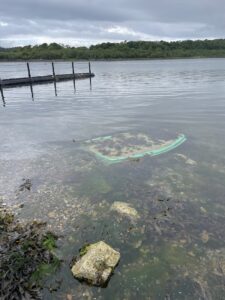
After trudging along the gravel beach I find, by the hotel’s floating pier more plastic and rope embedded in the gravel and sand. Further on a sunken plastic boat. You could not make this stuff up. Why a luxury hotel such as the Isle of Eriska does not clear all this up is beyond me.
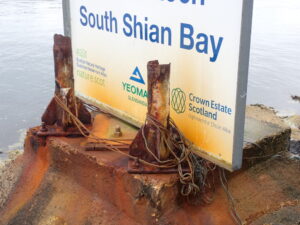
And then I arrive at the sign, a message to users as they enter the loch. ‘Loch Creran Marine Special Area of Conservation. Anchor in designated anchorages only.’ What does conservation conjure up in your mind? The dictionary tells us it means ‘the act of conserving; prevention of injury, decay, waste, or loss; preservation‘.
How ironic then, that this sign is adorned with the ever present plastic rope.
Whilst it’s true willy nilly anchoring and dredging have been stopped, very little else that is concrete and tangible and makes a difference seems to have happened. Alongside this Special Area of Conservation (SAC) the loch has also been designated as a Marine Protected Area (MPA).
When I tell people about the decline in the rare reefs what I hear is,
“But I thought they were protected?”
These designations whilst important can also be misleading. There is a big difference between calling somewhere protected and actually protecting it. An online article for children illustrates the point well. ‘In 2014, the entire Loch Creran was given a special status. It was declared a Nature Conservation Marine Protected Area. This means it is a protected area for nature.’
It is not. The decline continues.
And now for hanging my pod. But where was it? I set out with an additional bag and it was nowhere to be seen. As I retraced my steps my hip and knee joints complained. I really did not need any additional walking. Fortunately I found it by the pier gently lapped by the incoming tide.
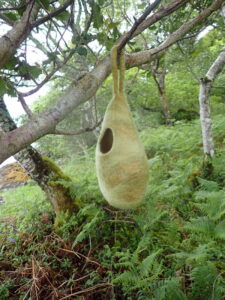
I will explain more about these pods, but for now know that somewhere on this walk there is a hand made felt pod containing a note written with seaweed ink on handmade paper. Left to degrade, the juxtaposition to the plastic pollution, symbolic of the choices we can make, to do no harm.
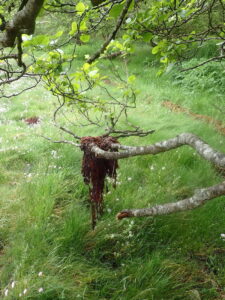
By the sign the rocks are slippy and steep above the fast running tide so I follow deer tracks through the undergrowth for a while. Then as South Shian bay and the loch open up the shore becomes easier, grass, gravel and areas of eroded clay.
With the end in sight I pass another mussel farm float, more embedded plastic and lots of seaweed on the fences and lower branches of trees. Then too late, I reach the crannog. I had so wanted to end atop this place where ancient people lived, but the tide has beaten me and I am wet enough already. Is there actually anything that can stand up to the Argyll rain? Squelching back to the bridge I concede my old walking shoes are definitely not up to the job. My feet are white and wrinkled as I peel of my wool socks. but my project, it has begun.
“The beginning is the most important part of the work.”
Plato

To follow these walks use the button below to subscribe to Mairi’s The Ripple Effect newsletter.
About the Author: Mairi

Latest Ripples
“If you wish to know the divine, feel the wind on your face and the [...]
“Hark, now hear the sailors cry, Smell the sea, and feel the sky, Let your [...]
"What we most need to do is to hear within us the sound of the [...]
"The voice of the sea speaks to the soul." Kate Chopin This morning I [...]
“The care of the Earth is our most ancient and most worthy, and after all [...]
"The question is not what you look at, but what you see." Henry David Thoreau [...]
“Instructions for living a life: Pay attention. Be astonished. Tell about it.” Mary Oliver After [...]
"As you move toward a dream, the dream moves toward you." Julia Cameron At last [...]
“Every artist was first an amateur.” Ralph Waldo Emerson As the painting continues I faced [...]
