


“What we most need to do is to hear within us the sound of the Earth crying.”
Thich Nhat Hanh
As I set off down the track to the magical tunnel I wondered what W. Anderson Smith would make of the shore between my home and his.

Magical tunnel, Dalintober track
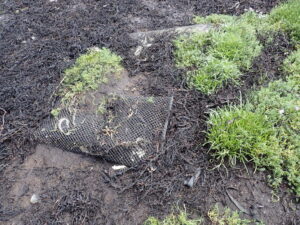
Shortly before reaching the incredible views, to the right, there is a collapsed shed full of old oyster farm equipment abandoned by previous farmers. Nature is slowly taking over. As my feet leave the track and crunch out across the pebbles there it is, first a black band and then two net bags buried in the grass. The oyster farm debris begins.
-
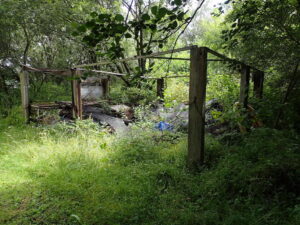
- Old oyster farm debris
-

- Black band
-
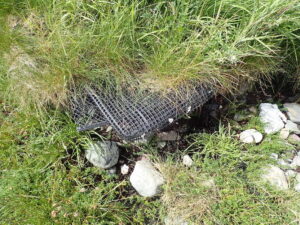
- plastic oyster bags
And I start counting.
After reaching sixteen I get out my notebook. One vertical line, then another, another and another, then the diagonal cross, that’s 21 so far.
Notebook entry:
“Oyster bags and black bands everywhere in first bay, and giant oyster shells. 42 up to the burn. Overwhelmed by the number of bags, haven’t even reached little woodland and burn yet.”
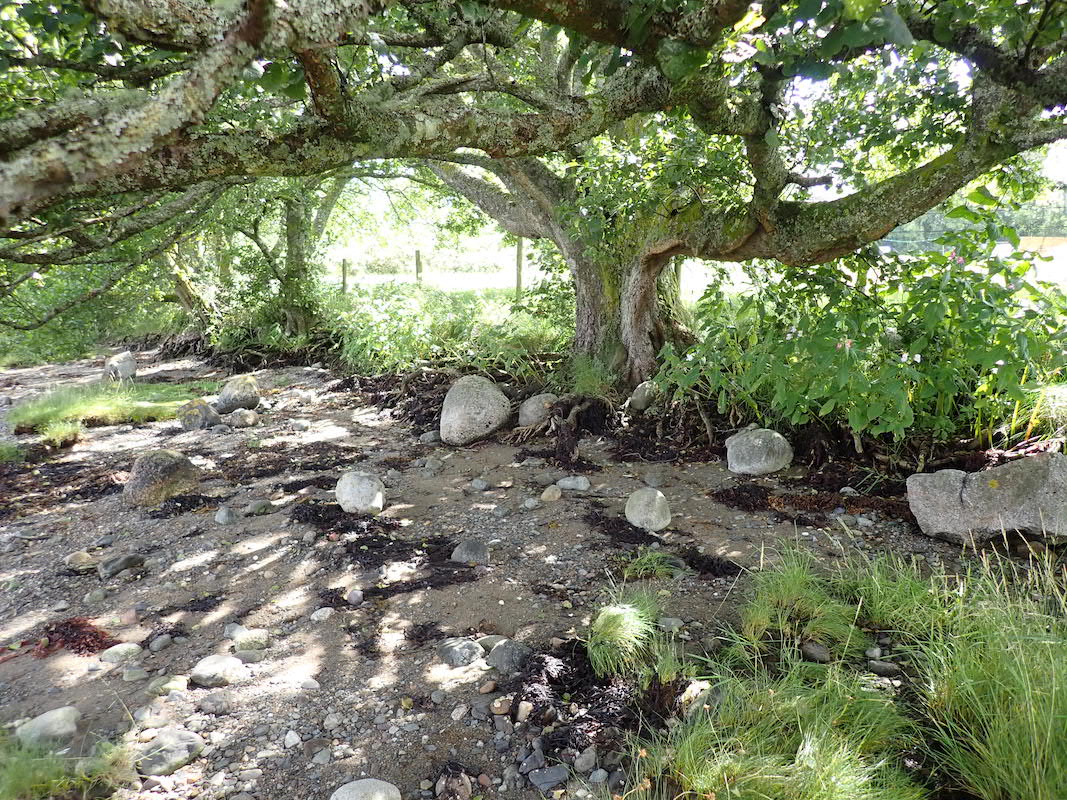
Alder trees
Thankfully there is respite by the alder trees I know so well, they feel like old friends. I often come here rain or shine for a wee sit. Then I notice the himalayan balsam has been bashed. I’ve since found out we can give thanks to the oyster farmers for tackling that.
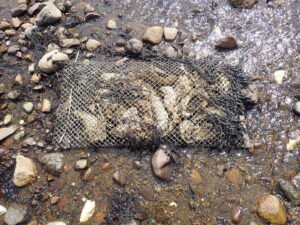
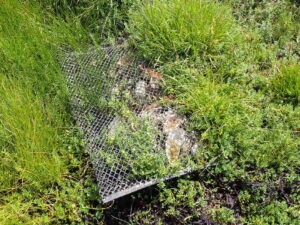
I do feel discombobulated though. One non-native species being tackled whilst another lies strewn along the shore. Although not classified as invasive pacific oysters are non-native and Nature Scot has Standing Advice for Pacific Oysters which includes biosecurity risk measures. You can read about these here. They include:
“No discarded shells, dead or alive, should be deposited on the seabed / intertidal zone.”
Interesting. I recently found a 20cm long monster with the remains of an oyster in it. I am curious about where it came from? Has a wild population established? Do they continue growing in the loose bags? What is going on?
When did anyone last check Loch Creran?
For comparison here is a photo of that giant pacific oyster alongside a normal size one, a native oyster, and a pound coin for comparison.

Oyster comparison
The 1861 Admiralty charts for this loch show that there were native oyster beds on the north shore. They must have been elsewhere too as Mr. Smith also refers to them.
“Sticking here and there about the rocks on the very verge of the lowest tide, are a lot of fine rock oysters, not too close to interfere with one another’s dinners, and so all fat, and fresh, and flourishing.”
As if by Divine intervention the Oyster Farmers arrive at the very spot where I have paused for a break. I take the opportunity to ask if they are aware of the number of bags along the bay, and of the gigantic oysters shells on the shoreline.
I’m not sure they are. Their activities take place in the low tide area, so maybe they do not know about the debris on the shore. They do now. I also let them know I’ll be blogging about this should they wish to comment. I explain that I am only recording not litter picking.
As I carry on I feel sick to my stomach. I hate confronting anyone but doing so with people I know, who run a local business is hard. However, pollution is pollution and plastic on the beach is plastic on the beach.
-
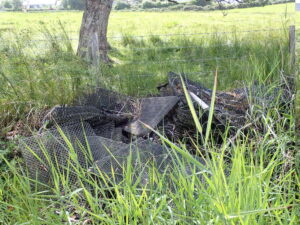
- Piles of old bags
-
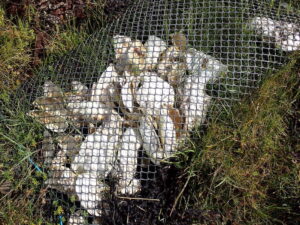
- Bag of old oysters
-

- Bags strewn by burn
I count 74 plastic oyster farm bags in total.
And that’s not all I find. Also lying around are a pile of empty bags enveloped by grass, mangled metal oyster trestles, odd bits of plastic, bottles and rope and two thick metal cables.
-
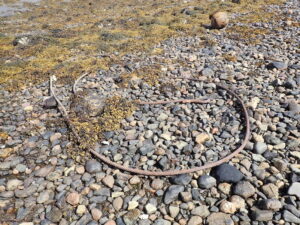
- Thick metal cable
-
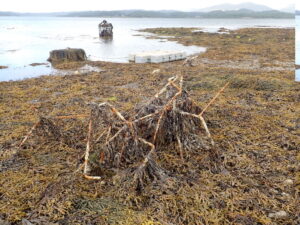
- Mangled old trestles
-
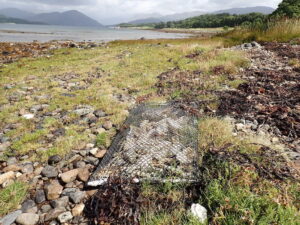
- A marred beach and view
Is there such a thing as plastic pollution fatigue? I think I’ve got it.
It is not easy to bear witness to, record and convey to you, all this detritus on the shore of what should be a pristine protected loch. I’m not even sharing everything I see, just the main things.
After passing a couple of mussel farm floats, an old fibreglass rowing boat and a big plastic tub I notice something orange by the water. It is one of several whole and broken clay pigeons. I recognise them because as a child I got paid to collect whole clays after my Dad had been shooting.
-

- Clay pigeon
-
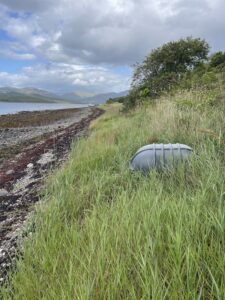
- Old mussel farm
-
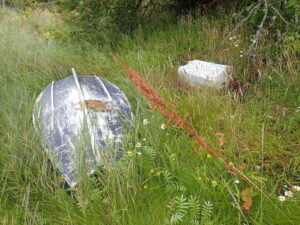
- Old boat and box
I then chat to someone whose family has been camping by the loch for over 40 years. They have no idea about the reefs or protected status of this loch. This is not unusual so I would appreciate help spreading the word about these walks.
This place needs our help.
I cross the quarry pier next and navigate a rather precarious steep section on its far side which is a bit scary. With 4 boats moored on the pontoons and at least two big boats using the mooring off South Shian the Glensanda super quarry creates a lot of marine traffic. There are currently no speed restrictions for Loch Creran, perhaps it needs some.
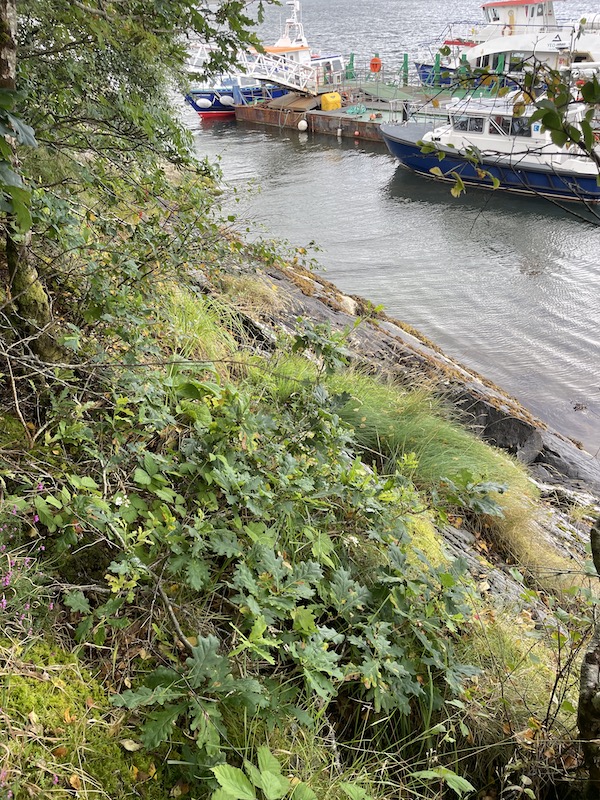
Quarry pier
Just before I enter Mr. Smith’s bay I hang my rhubarb root dyed felt pod at Rudha Garbh point. The bay feels familiar. I’ve read and re-read his book and continue to dip in to the month which relates to my walk, always fascinating.
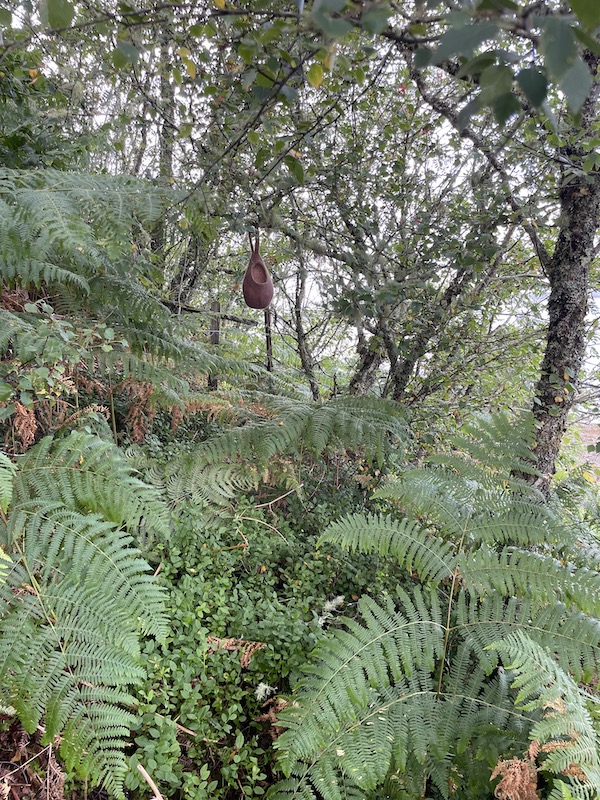
Felt pod
Arty stuff continues.
I stop to collect some seaweed and dock seeds which will become ink and pigments and then find a long blue pipe. In the end it went nowhere except into the undergrowth beside an old fishing buoy and a pile of rubbish.
Almost done I pass the old depuration site for the oyster farm and its amazing bank of shells, a modern day midden. Then, an old propellor shaft, some fishing floats, a plastic box, black plastic pipe and another old fibreglass rowing boat rounding off today’s shoreline debris.
-
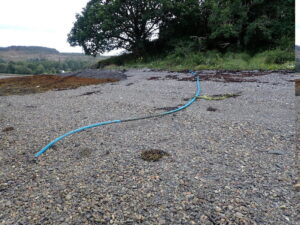
- Blue pipe
-
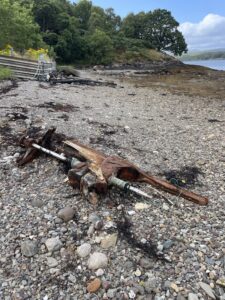
- Old propellor
-
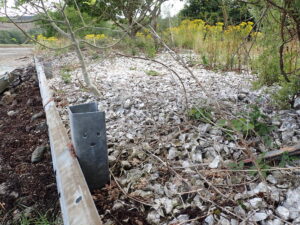
- A modern midden
Finally just below the cafe, what a stench, something nasty is seeping out here. I think it needs reported to SEPA.
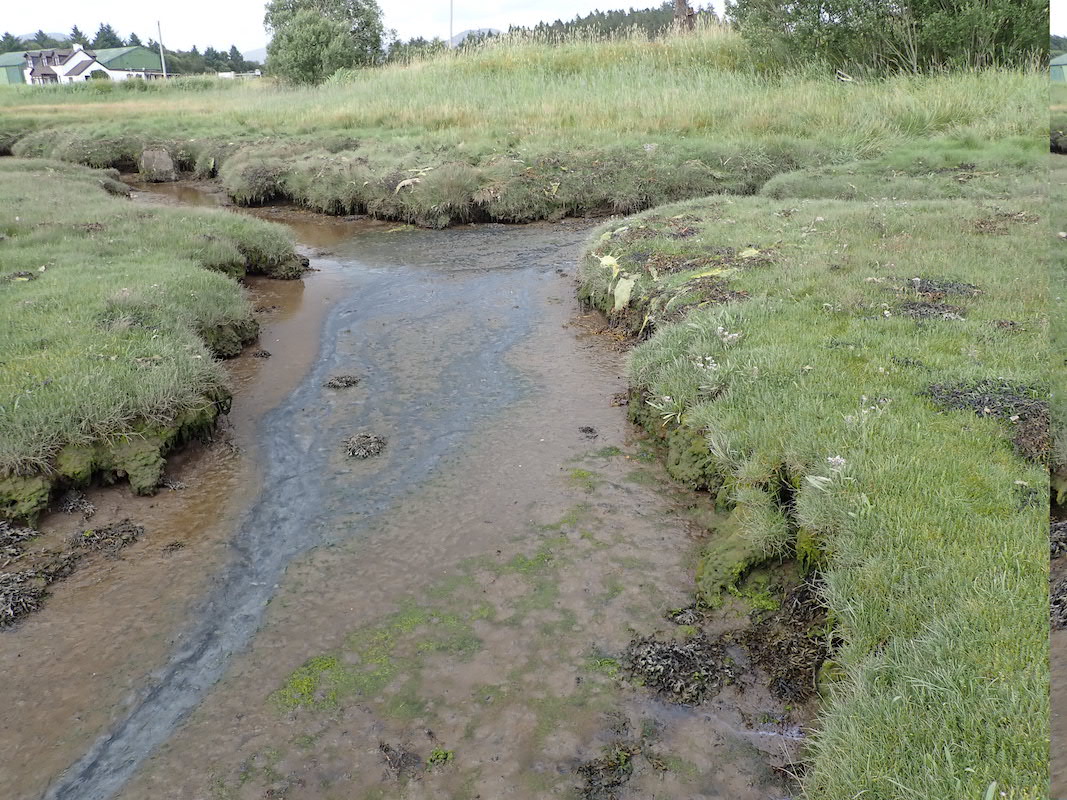
Seepage
I end out at the cairn so often mentioned by Mr. Smith. Here I contemplate what I have seen.
I wonder:
- Do the micro plastics in oysters come in part from the bags they live in?
- What about the serpulid worms, are they affected by mirco plastics?
- How many bags are there washing around in this loch?
- Do the oysters consume the same phytoplankton as the worms?
- Who decides the carrying capacity of this loch, there are 3 farms, could their consumption of phytoplankton affect other marine life?
- Apart from the regular e-coli checks are oysters ever checked for other pollutants, like the ones that showed up in the mussel research, for example?
- How many native oysters are left in this loch?
- Do they need to be protected too as has happened in other areas?
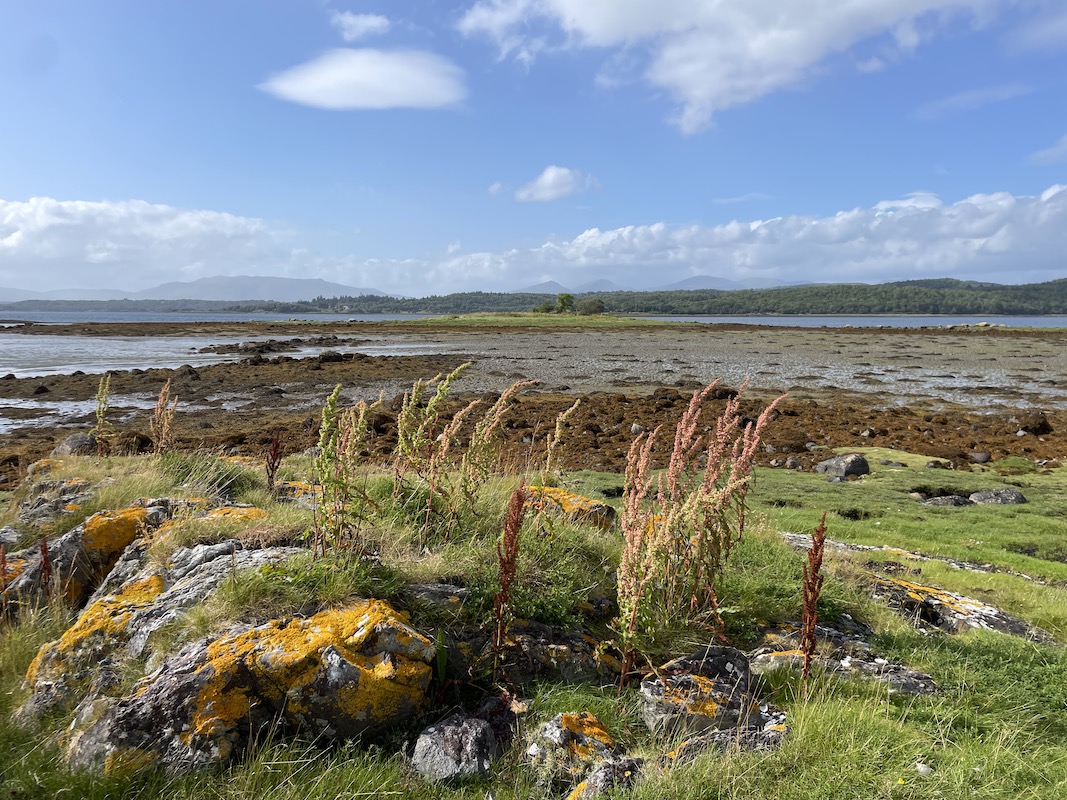
Mr. Smith’s bay
Lying back in the grass I contemplate all this as I look up and down this stunning loch. Humans have chosen to live in this special place for a very long time. Five thousand years ago they built this cairn, the crannog by The Isle of Eriska evidence of Bronze Age people and finally Mr. Smith and his book written 150 yrs ago.
Who will come next, what will they find, what legacy will we be leaving behind?
“There are no unsacred places; there are only sacred places and desecrated places.”
Wendell Berry
p.s.
When I reached the cycle path to start walking home I met a couple of hikers. Julie is walking the coast line of the whole UK! We compared adventures and the amount of litter and plastic we are finding, it’s not good.

About the Author: Mairi

2 Comments
Leave A Comment
Latest Ripples
“If you wish to know the divine, feel the wind on your face and the [...]
“Hark, now hear the sailors cry, Smell the sea, and feel the sky, Let your [...]
"What we most need to do is to hear within us the sound of the [...]
"The voice of the sea speaks to the soul." Kate Chopin This morning I [...]
“The care of the Earth is our most ancient and most worthy, and after all [...]
"The question is not what you look at, but what you see." Henry David Thoreau [...]
“Instructions for living a life: Pay attention. Be astonished. Tell about it.” Mary Oliver After [...]
"As you move toward a dream, the dream moves toward you." Julia Cameron At last [...]
“Every artist was first an amateur.” Ralph Waldo Emerson As the painting continues I faced [...]

It is really, really upsetting to see all that rubbish just left there. but you are leaving wee pieces of beauty as a counterpoint. Good to see.
Yes, the felt pods are symbolic, they will do no harm, a conscious choice. So often such choices are ignored for the sake of ease, convenience and of course profit. This was a particularly distressing amount of pollution, sadly there will be more.